

 “In order to take that train,” said Colonel Levering, sitting in the Waldorf-Astoria hotel, “you will have to remain nearly all night in Atlanta. That is a fine city, but I advise you not to put up at the Breathitt House, one of the principal hotels. It is an old wooden building in urgent need of repairs. There are breaches in the walls that you could throw a cat through. The bedrooms have no locks on the doors, no furniture but a single chair in each, and a bedstead without bedding–just a mattress. Even these meager accommodations you cannot be sure that you will have in monopoly; you must take your chance of being stowed in with a lot of others. Sir, it is a most abominable hotel.
“The night that I passed in it was an uncomfortable night. I got in late and was shown to my room on the ground floor by an apologetic night-clerk with a tallow candle, which he considerately left with me. I was worn out by two days and a night of hard railway travel and had not entirely recovered from a gunshot wound in the head, received in an altercation. Rather than look for better quarters I lay down on the mattress without removing my clothing and fell asleep.
“Along toward morning I awoke. The moon had risen and was shining in at the uncurtained window, illuminating the room with a soft, bluish light which seemed, somehow, a bit spooky, though I dare say it had no uncommon quality; all moonlight is that way if you will observe it. Imagine my surprise and indignation when I saw the floor occupied by at least a dozen other lodgers! I sat up, earnestly damning the management of that unthinkable hotel, and was about to spring from the bed to go and make trouble for the night- clerk–him of the apologetic manner and the tallow candle–when something in the situation affected me with a strange indisposition to move. I suppose I was what a story-writer might call ‘frozen with terror.’ For those men were obviously all dead!
“They lay on their backs, disposed orderly along three sides of the room, their feet to the walls–against the other wall, farthest from the door, stood my bed and the chair. All the faces were covered, but under their white cloths the features of the two bodies that lay in the square patch of moonlight near the window showed in sharp profile as to nose and chin.
“I thought this a bad dream and tried to cry out, as one does in a nightmare, but could make no sound. At last, with a desperate effort I threw my feet to the floor and passing between the two rows of clouted faces and the two bodies that lay nearest the door, I escaped from the infernal place and ran to the office. The night- clerk was there, behind the desk, sitting in the dim light of another tallow candle–just sitting and staring. He did not rise: my abrupt entrance produced no effect upon him, though I must have looked a veritable corpse myself. It occurred to me then that I had not before really observed the fellow. He was a little chap, with a colorless face and the whitest, blankest eyes I ever saw. He had no more expression than the back of my hand. His clothing was a dirty gray.
“’Damn you!’ I said; ‘what do you mean?’
“Just the same, I was shaking like a leaf in the wind and did not recognize my own voice.
“The night-clerk rose, bowed (apologetically) and–well, he was no longer there, and at that moment I felt a hand laid upon my shoulder from behind. Just fancy that if you can! Unspeakably frightened, I turned and saw a portly, kind-faced gentleman, who asked:
“’What is the matter, my friend?’
“I was not long in telling him, but before I made an end of it he went pale himself. ‘See here,’ he said, ‘are you telling the truth?’
“I had now got myself in hand and terror had given place to indignation. ‘If you dare to doubt it,’ I said, ‘I’ll hammer the life out of you!’
“’No,’ he replied, ‘don’t do that; just sit down till I tell you. This is not a hotel. It used to be; afterward it was a hospital. Now it is unoccupied, awaiting a tenant. The room that you mention was the dead-room–there were always plenty of dead. The fellow that you call the night-clerk used to be that, but later he booked the patients as they were brought in. I don’t understand his being here. He has been dead a few weeks.’
“’And who are you?’ I blurted out.
“’Oh, I look after the premises. I happened to be passing just now, and seeing a light in here came in to investigate. Let us have a look into that room,’ he added, lifting the sputtering candle from the desk.
“’I’ll see you at the devil first!’ said I, bolting out of the door into the street.
“Sir, that Breathitt House, in Atlanta, is a beastly place! Don’t you stop there.”
“God forbid! Your account of it certainly does not suggest comfort. By the way, Colonel, when did all that occur?”
“In September, 1864–shortly after the siege.”
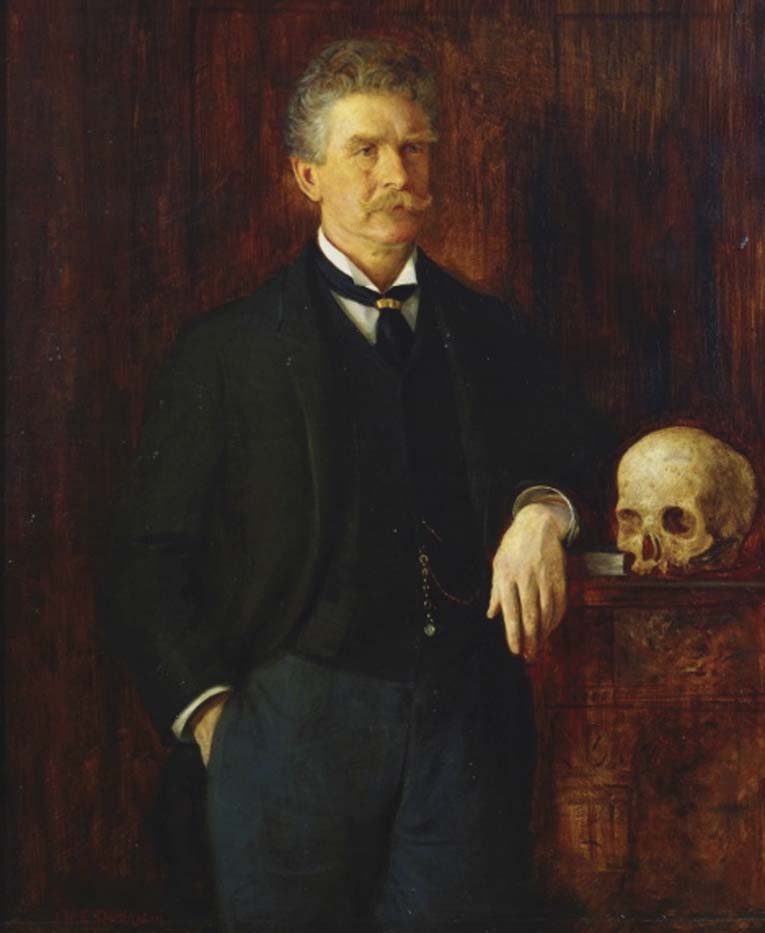
Ambrose Gwinnett Bierce (June 24, 1842 – circa 1914]) was an American editorialist, journalist, short story writer, fabulist, and satirist. He wrote the short story “An Occurrence at Owl Creek Bridge” and compiled a satirical lexicon, The Devil’s Dictionary.
According to Milton Subotsky, Bierce helped pioneer the psychological horror story. In addition to his ghost and war stories, he also published several volumes of poetry. His Fantastic Fables anticipated the ironic style of grotesquerie that became a more common genre in the 20th century.
In October 1913, Bierce, then age 71, departed from Washington, D.C., for a tour of his old Civil War battlefields. By December he had passed through Louisiana and Texas, crossing by way of El Paso into Mexico, which was in the throes of revolution. In Ciudad Juárez he joined Pancho Villa’s army as an observer, and in that role he witnessed the Battle of Tierra Blanca.
Bierce is known to have accompanied Villa’s army as far as the city of Chihuahua. His last known communication with the world was a letter he wrote there to Blanche Partington, a close friend, dated December 26, 1913. After closing this letter by saying, “As to me, I leave here tomorrow for an unknown destination,” he vanished without a trace, his disappearance becoming one of the most famous in American literary history. Skeptic Joe Nickell argued that no letter had ever been found; all that existed was a notebook belonging to his secretary and companion, Carrie Christiansen, containing a rough summary of a purported letter and her statement that the originals had been destroyed.
There was an official investigation by U.S. consular officials of the disappearance of one of its citizens. Some of Villa’s men were questioned at the time of his disappearance and afterwards, with contradictory accounts. Pancho Villa’s representative in the U.S., Felix A. Sommerfeld, was contacted by U.S. chief of staff Hugh Scott and Sommerfeld investigated the disappearance. Bierce was said to have been last seen in the city of Chihuahua in January.[32]
Oral tradition in Sierra Mojada, Coahuila, documented by a priest named James Lienert, states that Bierce was executed by firing squad in the town cemetery there. However, Nickell finds this story to be incredible. He quotes Bierce’s friend and biographer Walter Neale as saying that Bierce had not ridden for quite some time, was suffering from serious asthma, and had been severely critical of Pancho Villa. Neale concludes that it would have been highly unlikely for Bierce to have gone to Mexico and joined Villa.
All investigations into his fate have proven fruitless, and Nickell concedes that despite a lack of hard evidence that Bierce had gone to Mexico, there is also none that he had not. Therefore, despite an abundance of theories (including death by suicide), his end remains shrouded in mystery.
-By Ambrose Bierce