

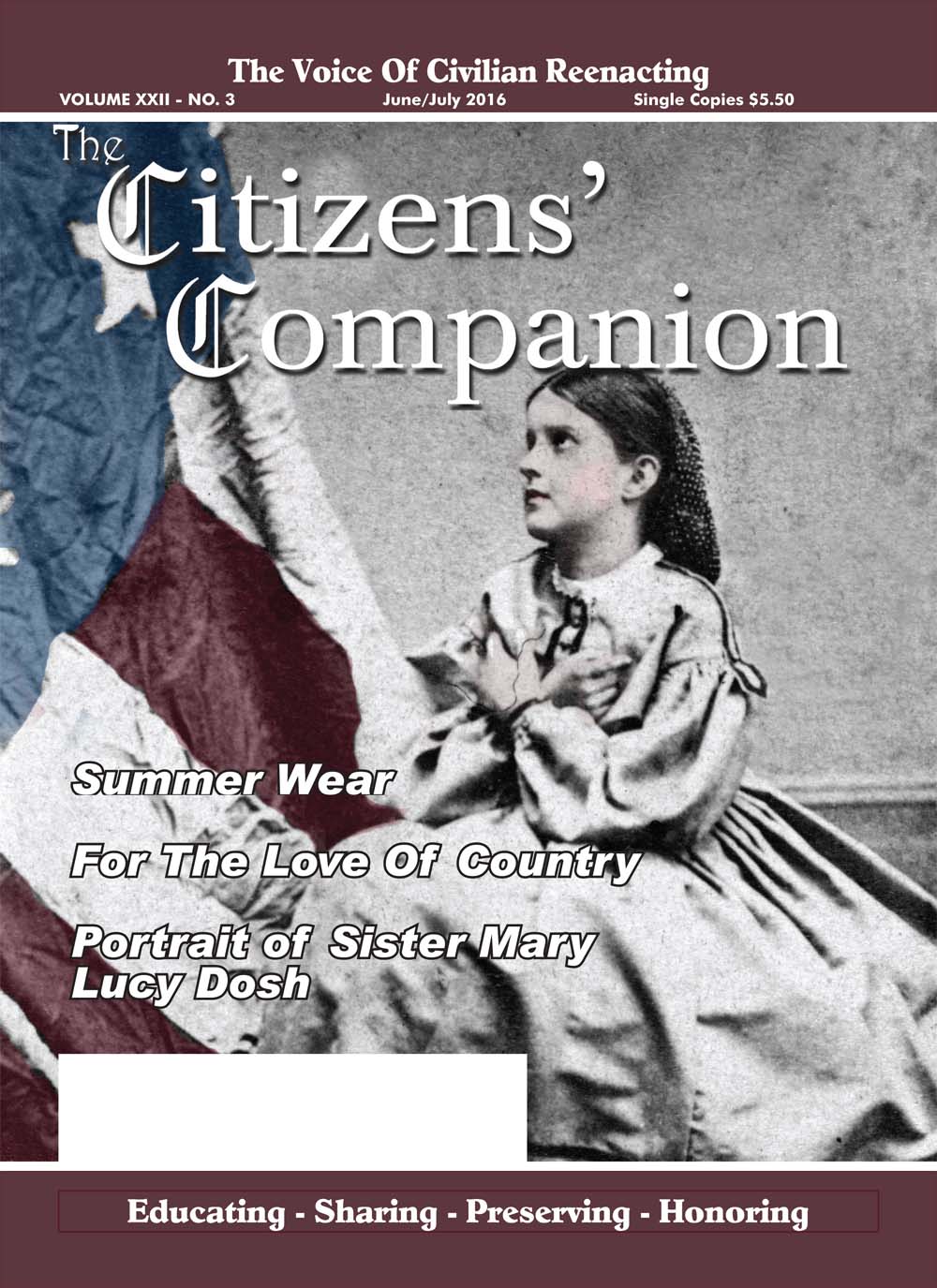
 For the new re-enactor to the established historian
I have been in this crazy hobby since 2002, when our oldest son was only 2 ½. Our second son was born into it, and has known nothing different then to pack up like a gypsy on the weekend and set up a tent city and dress up in historically accurate clothing and portray life from 150+ years ago. None of us that are part of this hobby see anything unusual about going out and camping in formal wear. What we do see as unusual is the different styles that people bring to the table. Some are spot on, step off the CDV page of accuracy. Others leave much to be desired. And then there are those that are either in the middle or so far off the end of either spectrum that people are left scratching their heads!
A discussion that comes up all the time on The Closet, as it is so fondly called, is what is accurate? What isn’t? Why is this not right but this is? What about Cold Mountain? Isn’t that accurate? And why is someone more right then someone else, and why are they picking on me!? I must admit, this is the HARDEST part of being an admin on the site. Balancing acceptance of someone new with those that have had years in the field is very hard, and sometimes brings up the most heated discussions.
As a new re-enactor there are certain things that some people will try to tell you that is passable: Battenberg lace parasols, fishnet gloves, head coverings called snoods in various colors, solid cotton blouses with printed or solid colored cotton skirts, cotton Medici belts (the diamond pointed back closing belts), coal shovel looking felt or straw bonnets, and these wonderfully floral and heavily beaded little hats that perch on your head and have loads of tulle dripping down the back side. Hate to tell all of you that are new, but these are all WRONG!!!!!!!!! No where in any form of documentation from the time period is any of this ever seen! These items are all things that were maybe passable 15yrs ago, but we have come so far forward in research and available materials and correct items that it no longer is acceptable or passes muster. They are purely items that are sold by vendors that obviously want to make money, and these things can be purchased and sold cheaply. Also not acceptable are polyester gowns with heavy velvet jackets, or something that looks like should have been curtains for your kitchen. Cotton dresses with giant pagoda sleeves are also a no-no! Through research and original artifacts, there is little that shows such things existed. Nylons do not pass for proper stockings, nor does shorts or yoga pants under your hoops. And please, if you purchase anything, buy a petticoat for your hoops! It’s very noticeable to everyone when you don’t have one.
Being a lady of the 19th century requires effort, not just a concept of “looking pretty”, and it’s sometimes hard to wade through all of the information on The Closet to find exactly what you’re looking for. The search area is great, and it will save you time when you’re there so you don’t have to ask the same question over again. Also, there are LOADS of files there of great sutlers and research tools. It is also very easy to get the “right” look the first time instead of wasting money on purchasing things over and over again. Had I had a mentor that was more accuracy oriented I would not have wasted a lot of money in my first three to four years of re-enacting. We all start somewhere, and it is where you end up is what matters. Members of the Closet try very hard to help everyone that asks for help how to avoid these financial pit falls.
I find that balancing acceptance and accuracy is a struggle. For myself I have become somewhat intolerant to some faux pas that have been “accepted” for years, and that is because I find no reason for them to be out there any longer with the amount of research that is available. The biggest one is the solid colored cotton blouse with the cotton skirt of print or solid color. This discussion has come up time and time and time again in The Closet. The ensemble itself existed as a high fashion outfit of a fine cotton, silk or wool body (what we would call a blouse) paired up with a silk or wool skirt. The fashion started with the youthful ladies, and did spread to those ladies of maturity that were of fashion forward thinking. These ensembles were elegant, often sported a velvet Spanish jacket or wool Zouave style jacket, but not in any amount of research does it show that it was a solid colored cotton blouse with a calico printed skirt. This was a creation invented for sales at events that was easy and cheap to put together. A more accurate solution for first time re-enactor ladies is the simple wash dress: gathered or pleated at the front and attached to a skirt, often sporting bishop sleeves and a simple white collar. This ensemble is far more acceptable then the afore mentioned cotton concoction. Advice such as this has been given repeatedly on The Closet, so the research is out there.
On the flip side, no one has said that every lady re-enactor out there needs to be adorned in full silk and wool all the time. Often we hear from new re-enactors that “we can’t afford silk”, but no one has asked you to wear it all the time. Silk is an expensive modern fabric, that was more readily available in the 19th century. Cotton is very acceptable when put into the context of a pleated or gathered bodice dress with coat or bishop sleeves. Adorned with a white collar and cuffs, this look can be accomplished for a reasonable price by all new re-enactors. The thing to remember is that all prints are not created equal. Careful study is needed to make sure that the correct style of pattern is used, for modern calico prints are not the same as period reproduction patterns. There are many books available that will aid in the selection of period correct fabrics, and will help you save money in the long run. Save your silk for your ball gown, and invest in tropical or suiting weight wool for your best day dress. It is always good to remember that it is better to have two or three great dresses then a wardrobe of inaccurate dresses. Though you may see yourself in the same thing over and over again, the general public at events won’t know the difference.
So why so much discontent between those that know and those that are new? What seems to be a prominent theme on The Closet is that those that know and share their years of research are sited as being bullies, know it alls, stitch counters and more. Those that are new and choose to go the route of “pretty”, and “ I don’t care, I’ve done it this way for years and it’s just fine” are looked at as Farbs, inaccurate, and a shame to the hobby. This creates animosity for sure, and causes arguments in discussions. It really is the most disheartening part of the hobby and makes many of us depressed and lack lustered. I consider myself a “progressive” re-enactor; meaning that I want to take steps to make my impression as accurate as possible, and do so not all at once, but by making upgrades each year to my impression. That involves research! One must do research to find what is appropriate not only for their social station at that time period, but also for the hobby. For me, and many other progressive re-enactors, it has gone far beyond “looking pretty” and “playing dress up”. We take this seriously, and put great amounts of energy and effort into our impression. This tends to give off the impression to those that are either new or have fought to move forward, that we are being pushy with our ideals and standards. BUT if we don’t have standards to strive for, and that goes for anything in life, then are we not just stagnant and not working to our full potential? We are accused of being the N word (reference to a group of Germans from WWII) and being bullies. That is far from the truth. Many of these folks that are accurate in their impressions have worked YEARS to get to that point, and have freely shared their great amount of knowledge on the Closet to help those that don’t really have a starting point. What we do find is that those that fight this kind of accurate and well researched information don’t wish to find out that their information is in fact wrong or skewed, or are what we fondly have dubbed “re-enactorisms” (information that has been passed down from re-enactor to re-enactor with no formal documented basis).
We as seasoned re-enactors must be tolerant of the different levels of accuracy standards. We must understand that not everyone out there wants to be accurate to the level that we are at. It is hard, because all most of us want to do is go up to the pretty Scarlet princess and tell her right out what is all wrong with the velvet and cotton drapery fabric confection she is sporting. It is not our place. If they wish to have help, there are ways of doing it and doing it subtly. If new folks to re-enacting feel that they are being “attacked” or “torn down/apart” they may leave the hobby for another one and never come back because of their experiences. It is a risk that every hobby faces, but seems to be very prevalent in Civil War re-enacting. We don’t want to degrade someone that is truly trying, and patience is what is needed. Some of these ladies will go on to become some of the most accurate and happy re-enactors out there with helpful guidance and encouragement. Others will never wish to shed their fluffy concoctions, and the realization is that not everyone will want to be at the same level as others out there.
On the flip side, new and established re-enactors working on up grading, or who have been in the same rut for years, need to understand that those that have this great amount of knowledge are doing everyone a service by freely sharing this information. They aren’t charging you, they aren’t trying to bully you. They are trying to educate you and help you. It is hard to be told that your ensemble that you just paid over $200 for isn’t correct, or that your coveted Battenberg lace parasol isn’t accurate, but the reality is that we all make mistakes and to learn from those makes us all better people. Take this great information and be sparked to start your own research. If you don’t agree with what is being provided to you, that is your decision, but then find the information out there to back your statement, and not just “Well if they had it they would have used it”, because that is not primary documentation.
It boils down to tolerance, acceptance, guidance, and an open mind to learn! We are all in this hobby for our own purposes, but we are also in this hobby for the same reason: To represent the past, pay honor to our ancestors, and to recreate a time gone by. Though we may not all do it the same way, we can all help each other. Those that are new help us that have been doing this for a while to become re-invigorated in the hobby by finding new research to dig into. Those that are established can find happiness in continuing to move forward with our impressions but also to bring new folks into the fold. If we all work together, we can accomplish a great deal, but we need to do it with kindness.
Bio- Jenna Theissen has been a re-enactor of the American Civil War since 2002 when she and her family formed the civilian organization called The Historical Timekeepers (www.historicaltimekeepers.org) for the purpose of portraying the home life of middle class northern Americans. She is also the creator of the Facebook pages The Civilian Civil War Closet and the Sewing Sisters, both with the purpose of helping and educating others. Her passions are her family, sewing and researching the American Civil War, and she fondly will tell you “I use to have a life, now I reenact someone elses.”
-By Jenna Theissen