

Creative Cockades,
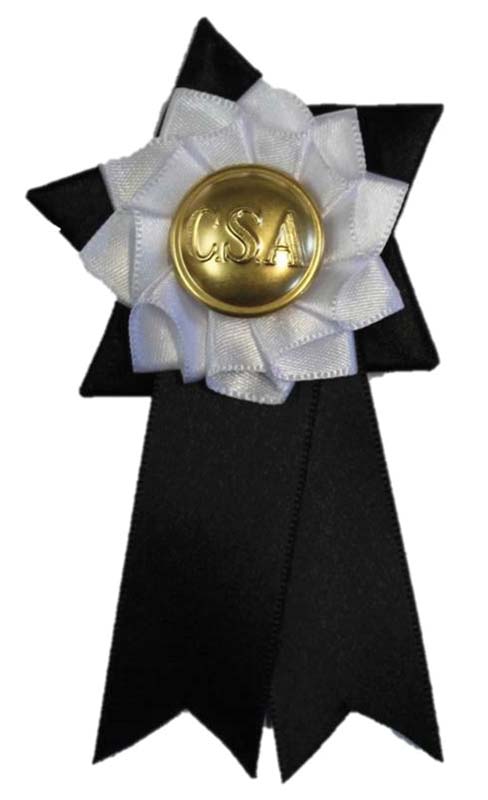
Black and White Secession Cockade
This article is about two Northern women with secession cockades. One wore them, the other made them – but for very different reasons.
Lady Spy
The first story starts with the Pinkerton Agency, established in 1850. This private detective group became famous when they supposedly foiled a plot to assassinate Abraham Lincoln in 1861.
Allan Pinkerton, the man in charge, employed many people to be his secret agents in this operation. One of them was a lady named Kate Warne.
There is apparently no surviving picture of Mrs. Warne, but Pinkerton provided a wonderful word picture of her in his book about the plot. “Of a rather commanding person, with clear-cut, expressive features, and with an ease of manner that was quite captivating at times, she was calculated to make a favorable impression at once….She was a brilliant conversationalist when so disposed, and could be quite vivacious, but she also understood that rarer quality in womankind, the art of being silent.”
Kate Warne was given the task of getting to know the wives and daughters of the conspirators in Baltimore, to gain information of the plot from them.
Maryland was seething with both secession and anti-secession fervor in early 1861. Mrs. Warne’s one major drawback, that of being from the North, was easily overcome. “She was of Northern birth, but in order to vouch for her Southern opinions, she represented herself as from Montgomery, Alabama, a locality with which she was perfectly familiar, from her connection with the detection of the robbery of the Adams Express Company, at that place. Her experience in that case, which is fully detailed in “The Expressman and the Detective,” fully qualified her for the task of representing herself as a resident of the South.”
But the crowning subterfuge Mrs. Warne used was – you guessed it – a secession cockade. Pinkerton tells us that she “displayed upon her breast, as did many of the ladies of Baltimore, the black and white cockade, which had been temporarily adopted as the emblem of secession, and many hints were dropped in her presence which found their way to my ears, and were of great benefit to me.”
I have seen a number of those early black, or black and white secession cockades. Mrs. Warne’s cockade was no doubt a striking public statement. So the next time you see a reenactress playing the part of a Northern spy, ask her where her secession cockade is.
Womanly Patriotism
My second story tells of a Northern woman who is not only faceless but nameless as well. We know that she was from New York. And we know that a previous family member – possibly her grandfather – was a Revolutionary War hero.
This young lady apparently was old enough to remember the patriotic fervor 14 years earlier during the Mexican War. Or perhaps her father fought in that war and told her the stories. Either way, she was obviously a young woman who was proud of the men who fought for her country.
So when one of the Mexican War heroes was elected to office in the Confederacy, she paid tribute to his gallantry with – yes, indeed – secession cockades.
A brief, poignant newspaper account tells the story.
“A Northern Girl’s Tribute. ‘The Montgomery correspondent of the Columbus (Ga.) Sun says President Davis has received a present of some twenty very beautiful cockades, from a young lady living in one of the interior towns of New York. They are made very tastefully, and some of them are ornamented with the palmetto button. The young lady says she is a descendant of one of the heroes of the battle of Ticonderoga. She congratulates Gen. Davis in very high terms on his election as the first President of the Confederate States of America, and in conclusion says she, a Northern girl, pays this tribute as her heartfelt admiration of the gallant soldier who led the glorious charge at Buena Vista.’”
Just as there were Southern ladies who favored the Union cause, there were Northern ladies who preferred the Confederate side. The war was a time of deep divisions, even in families, and the issues were not as cut and dried as history textbooks might lead us to think.
Regardless of their sympathies, it’s clear that the ladies of the 1860s showed the courage of their convictions in many ways – not the least of which was in their cockades.
Heather Sheen is an international specialist on cockade history. A living historian and avid history buff, Heather enjoys researching the stories behind the cockades. You can read more stories at her website, as well as purchase reproduction cockades. www.creativecockades.com.
-By Heather Sheen